the hypernormalisation of america

By | December 9, 2020

People didn’t need to believe Trump, they just needed him to confirm that their decision to believe in nothing was right. A conspiracy theory isn’t about believing something — it’s about believing that what is in front of you is not the truth, not the reality. So a conspiracy theory is a bamboo scaffolding flexible enough to frame anything you like, so long as it fits your core suspicion that the world is not as it seems. Trump’s embrace of the Birther lie — one that 3/4 of Republicans, and ⅓ of Americans believe is true — enabled him, and therefore them — to reject Obama’s presidency as a fraud. As Anne Applebaum put it:

That third of Americans went on to become Trump’s base. Over four years, they continued to applaud him, no matter what he did, not because they necessarily believed everything he said, but often because they didn’t believe anything at all. If everything is a scam, who cares if the president is a serial liar? If all American politicians are corrupt, then so what if the president is too? If everyone has always broken the rules, then why can’t he do that too?

This is not dissimilar to the analysis presented by Adam Curtis in “HyperNormalisation“, which merits watching a few times. The title is taken from that grim fairyland of the Soviet Union:

The Soviet Union became a society where everyone knew that what their leaders said was not real because they could see with their own eyes that the economy was falling apart. But everybody had to play along and pretend that it WAS real because no-one could imagine any alternative. One Soviet writer called it “hypernormalisation”. You were so much a part of the system that it was impossible to see beyond it. The fakeness was hypernormal.

But Curtis realised it applied to a lot more than a decaying communist empire. Hypernormalisation had evolved to embrace Putin’s Russia, where opposing sides in the battle were being funded and directed by the same hand, and even Trump’s America. Curtis’ genius is to chart this path and see the common thread: leaders who could sell any version of reality they wanted. The situation now is in some ways the natural conclusion of his analysis — the documentary appeared in 2016, before Trump’s victory. Here’s how Curtis effectively concluded his screed:

But underneath the liberal disdain, both Donald Trump in America, and Vladislav Surkov in Russia, had realised the same thing – that the version of reality that politics presented was no longer believable, that the stories politicians told their people about the world had stopped making sense. And in the face of that, you could play with reality, constantly shifting and changing, and in the process, further undermine and weaken the old forms of power.

We have been constantly frustrated by Trump’s asserting lies as truth, by his accusing the other of crimes he has (instead) committed himself. This is a playbook as old as authoritarianism itself, but in the Information Age, we had hoped would be one that would be harder and harder to use. But a surplus of information is the same as a deficit; it is as hard to find needle in a haystack as it is in an empty field. Trump’s instinctive genius has been to pull out the rug of legitimacy from the presidency, and by exposing the holder of it as a fraud, cheapen it enough to turn the votes that fill it into junk as well. As Anne Applebaum says, he was throwing shade on fertile ground. The institutions had already ceased to matter for many Americans.

So Trump played with reality, and will continue to do so, because that is the hallmark of demagogues; charismatic leaders wrap themselves in the trappings of office, but those trappings, and those offices, are largely fictional affairs. More important for him, and all instinctive autocrats, is to ridicule all institutions — including those outside government, like the media — so there is no credible alternative. Part of the trick is to create momentum — or the illusion of it — by always shifting gear, always throwing sand in the eyes of opponents, to turn politicians, civil servants, generals into lickspittles, and — his own twist on it — to turn it into a reality show, where we’re always ‘waiting to see what will happen’. There is no finale, only more addictive dramatic tension.

We still don’t quite understand this. We still imagine there is some rational level upon which all this operates — Trump, his followers, Russia, Johnson, populism — and that that is where we fight our battles, with well-honed reason and rules-based politicking. But as Curtis has pointed out, the version of reality that conventional politics presented is no longer believable. This is not cynicism at work here, it’s the algorithm. As Curtis describes:

The liberals were outraged by Trump. But they expressed their anger in cyberspace, so it had no effect – because the algorithms made sure that they only spoke to people who already agreed with them. Instead, ironically, their waves of angry messages and tweets benefitted the large corporations who ran the social media platforms. One online analyst put it simply, “Angry people click more.” It meant that the radical fury that came like waves across the internet no longer had the power to change the world. Instead, it was becoming a fuel that was feeding the new systems of power and making them ever more powerful. But none of the liberals could possibly imagine that Donald Trump could ever win the nomination. It was just a giant pantomime.

This is old news now, and we are hoping that it will be addressed. After all Twitter and Facebook are being proactive about flagging and removing offensive content, even if it’s from the President of the United States, right? I can’t help thinking of horses and barn-doors and bolts. The issue is no longer trying to prevent misleading information from social media. Social media itself is, by definition, unfiltered information and so therefore misleading. If I watch a video on Youtube titled ‘Buffaloes Rescue Baby Elephant from Lions‘ am I sure what I’m seeing is that? Or Buffaloes Stop 2 Male Lions From Killing Another Lion? Is that really buffaloes protecting an elephant or a lion, or something else entirely? Just as likely, at least in the second case, is that the buffaloes want the lion for themselves. In the first case, it’s just as likely the buffaloes just want the lions out of there. But I have no way of knowing from the video, the caption or the comments. I’m no wiser at the end of it as I was at the start.

Social media, is by definition social, and so it’s unfortunately open ended, subject to discussion, trolling, misdirection and confusion. To extend what Curtis says, all this largely contextless ‘information’ merely feeds the new systems of power which rely on confusion, and a lack of respect — even contempt — for institutions.

When you believe your president should never have been elected president, then why should you have any respect for him, for the office, and for all the arms of government under his control? And now we are faced with the reverse image of this. Where Trump won the presidency by denigrating it as an institution and ridiculing all those who challenged him for it, so he will create a new fiction, as Applebaum explains:

Even if Trump is forced to make a grudging concession speech, even if Biden is sworn in as president on January 20, even if the Trump family is forced to pack its Louis Vuitton suitcases and flee to Mar-a-Lago, it is in Trump’s interest, and a part of the Republican Party’s interest, to maintain the fiction that the election was stolen. That’s because the same base, the base that distrusts American democracy, could still be extremely useful to Trump, as well as to the Republican Party, in years to come.

Trump, and those who may see political or financial profit, will plough this furrow for as long as they can. But there’s a worse outcome, and one that seems to be playing out as I write this. It’s one highlighted by Barton Gellman, and it’s entirely consistent with Adam Curtis’ portrayal of a world where nothing is as it seems.

The worst case, however, is not that Trump rejects the election outcome. The worst case is that he uses his power to prevent a decisive outcome against him. If Trump sheds all restraint, and if his Republican allies play the parts he assigns them, he could obstruct the emergence of a legally unambiguous victory for Biden in the Electoral College and then in Congress. He could prevent the formation of consensus about whether there is any outcome at all. He could seize on that un­certainty to hold on to power.

Now I’m not here to write a political screed. I’m here to focus on the technological aspects of this. All narratives which try to define the reality in front of us were, before the era of social media, largely in the hands of those with power — political, financial, or otherwise. By power, I mean the establishment. Most of the media is free — I know, I worked for it — but it has always hewed along the same grain as the establishment it reports on, and which it holds to account. The standards it adheres to, the rules it checks for abuses of, are agreed upon. When Woodstein took on Nixon, they were accusing him of breaking very specific laws and norms, ones that (nearly) everyone agreed on.

These did change over time, as Curtis shows, and sometimes the reality, the norms, seemed to crack, as if The Matrix was buckling. We can see them clearly in the rear-view mirror: the demonisation of regimes (and their rehabilitation, or the reverse): Gaddafi, Saddam, Noriega. And before them the Soviet Union, whose sudden collapse surprised everyone. As Curtis put it:

Reality became less and less of an important factor in American politics. It wasn’t what was real that was driving anything or the facts driving anything. It was how you could turn those facts or twist those facts or even make up the facts to make your opponent look bad. So, perception management became a device and the facts could be twisted. Anything could be anything. It becomes how can you manipulate the American people? And, in the process, reality becomes what? Reality becomes simply something to play with to achieve that end. Reality is not important in this context.

But now this warped reality is coming home. No longer is it about “over There”, it’s about Here. Trump, Giuliani, Barr, and now McConnell are all feeding a narrative that takes us into new territory: Americans are being persuaded to believe there was no clear outcome to the election. That is essentially doing away with democracy, replacing that flimsy but long-adhered to scaffold with another: the reality that not only does your vote not matter, but the count doesn’t matter either.

And the tools being used to forge that new uncertainty are largely online.

Steve Bannon’s call for Anthony Fauci to be beheaded was on Facebook for 10 hours. Only when journalists quizzed Facebook did it take down a group calling for members to ready their weapons should Trump lost his bid to stay in power. According to Reuters

Such rhetoric was not uncommon in the run-up to the election in Facebook Groups, a key booster of engagement for the world’s biggest social network, but it did not always get the same treatment.

A survey of U.S.-based Facebook Groups between September and October conducted by digital intelligence firm CounterAction at the request of Reuters found rhetoric with violent overtones in thousands of politically oriented public groups with millions of members.

Even Fox (admittedly for its own reasons) cut away from a White House press conference alleging voter fraud without any substantiation, while Facebook ran it unmediated. After being prompted Facebook added a closable label to it.

I’ve said it before: eventually social media must become media, in that it will have to police itself and content on it in the same way a media organisation does. But that day may be too late. Social media has been shown to be a clear and present danger to democracy. It is easily manipulated — by professionals like Putin, and demagogues like Trump — and can quickly subsume us. It’s not because it radicalises, although it can do that, but because it can breed a sort of existential despair, in which disinformation, misdirection and the hypernormalisation of ambiguity, uncertainty, and alternative facts.

COVID’s other long shadow

By | October 21, 2020

The Nettox. ( Photo courtesy of Irfan Budi Satria)

It will take some time for the true toll of the coronavirus pandemic to be known, but for me one of the most invidious, and unnecessary, costs will be for the generation of kids uneducated and lost to screen addiction. Nowhere is it more visible than in Indonesia.

Take the daughter of a friend: let’s call her Aneesa (not her real name), a 12-year old who will shortly be shipped off to an Islamic boarding school, or pesantren, where she will spend three years memorising the Koran. This is because her state school has been shut since the end of March, and she has been left by her parents and teacher to study online, which mostly means alone. The teacher will send instructions by WhatsApp of what to read and students will send in their assignment the same way. Which means the students will effectively have a phone by their side from 7 am to 2 pm, without interruption or supervision.

Under such conditions it’s unsurprising she had become addicted to games, Youtube and social media; even her three year-old cousin has access to a phone and is similarly addicted. Although I don’t think the solution, to pack her off to a pesantren, was necessarily the right one, you can understand the frustration — and the lack of resources — that led to it.

Cellphone addiction is nothing new in Indonesia. A study published last year1 by researchers at the University of North Sumatra found that three quarters of boys and girls in Aneesa’s age-group were addicted to their smartphones. A study (PDF) by researchers at Padjadjaran University in Bandung2 the same year found that 26% of students they studied had “mental, emotional disorders with smartphone addiction.” They found a clear correlation between smartphone addiction and mental and emotional problems of early adolescents.

This is depressing, but unsurprising. COVID aggravates the problem in particularly pernicious ways. On the one hand children are being pushed towards their gadgets to study remotely. But it’s those same gadgets that they are being drawn to. So the school-work doesn’t relieve them of their addiction, it just reminds them of it, and is an obstacle to be overcome.

The other problem is time. At what point does playing with a gadget become an addiction? A study (PDF) by different researchers at the University of North Sumatra in 2019 of elementary school students3 found “a significant relationship between the respondent’s mental emotionality on the number of hours of gadget usage in a week.” It concluded that children should play with gadgets less than 40 minutes a day, less than three times per day and between 1 and 3 days a week. It found that 28% of the kids studied registered on the mental emotional scale as abnormal, and 36% were borderline.

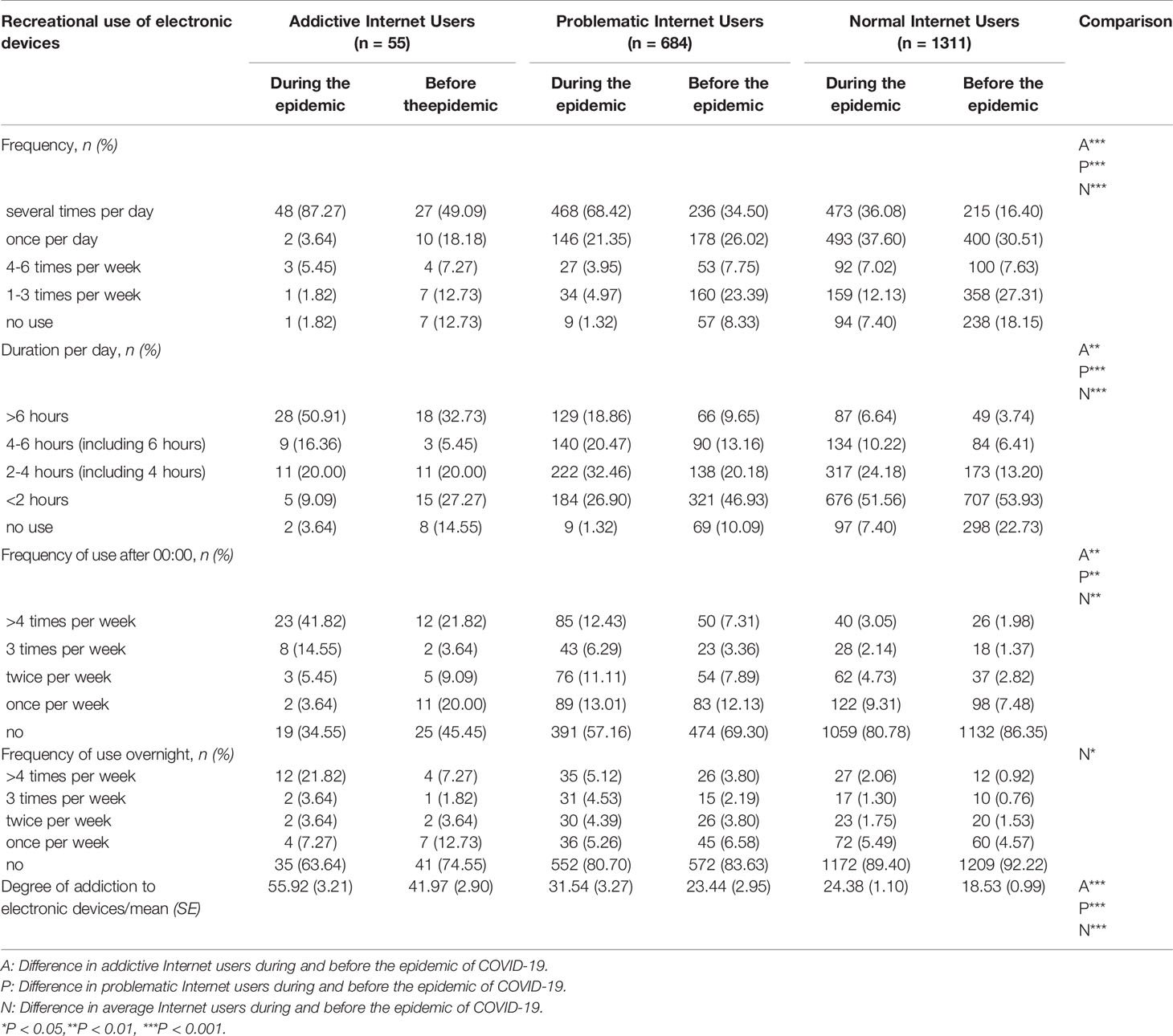
The problem with lockdown is that time is no longer a scarce resource. And with parents harried and distracted, under-resourced or -motivated teachers either phoning it in or not phoning in at all, kids have easily scaled the walls of any constraint on screen time. A study (PDF) by Chinese researchers in Changsha4 found a doubling in the frequency of using electronic devices recreationally among children and adolescents during COVID. (More than half of those considered addictive users were on their devices more than six hours a day.) (You can see the table here.)

This is a whirlwind that will reap away a generation of kids and adolescents. My friend Aneesa will miss a vital three years of education, but truth be told she wasn’t getting much anyway. None of this is her fault. The lack of government effort to ensure children’s education is not too damaged by COVID is in part to blame. But not all.

For we have helped create this beast. The addiction to these devices, like cigarettes, is not an unfortunate byproduct of their success. It is the reason for their success. Every game, every Facebook tweak, every Youtube video suggestion and autoplay on-by- default setting, all feed addiction. Each is an ingredient in the nicotine of the reason for these gadgets.

We need to take a long hard look at who and what is responsible for this, and who and what we should be cheering. Indonesia has long been an early adopter of technology and has one of the highest smartphone usage rates in the world. Back in 2014 it topped a survey (PDF) of device usage in 30 countries compiled by Millward Brown AdReaction, with Indonesians spending an average 3 hours a day on their phone, and a total 9 hours across TV, tablet, smartphone computer.

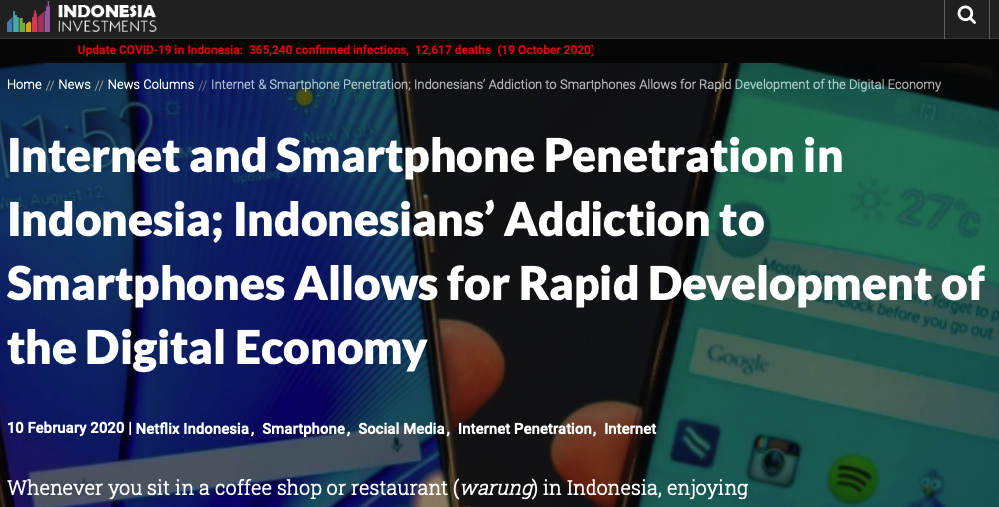
The thing is this addiction is seen as a good thing, commercially. Mobile commerce has really taken off in Indonesia, and addiction has fed this. See this headline for an “Indonesia Investments” newsletter: Indonesians’ Addiction to Smartphones Allows for Rapid Development of the Digital Economy.

No real effort has been made to wean kids off this addiction: a worthy effort by a team of Indonesian students got some press in late 2019, but the inventor behind Nettox, Irfan Budi Satria, told me “the invention itself was a product developed for a student competition, and early on it was never really our intention to commercialize it.” An initiative by the government of Bandung, a city southeast of Jakarta, handed out chicks to seventh-graders in December in the hope of building their character and diverting their attention from the screen. It was, inevitably, called chickenisation, and its fate is not known.

Addiction is good. For some (screenshot)

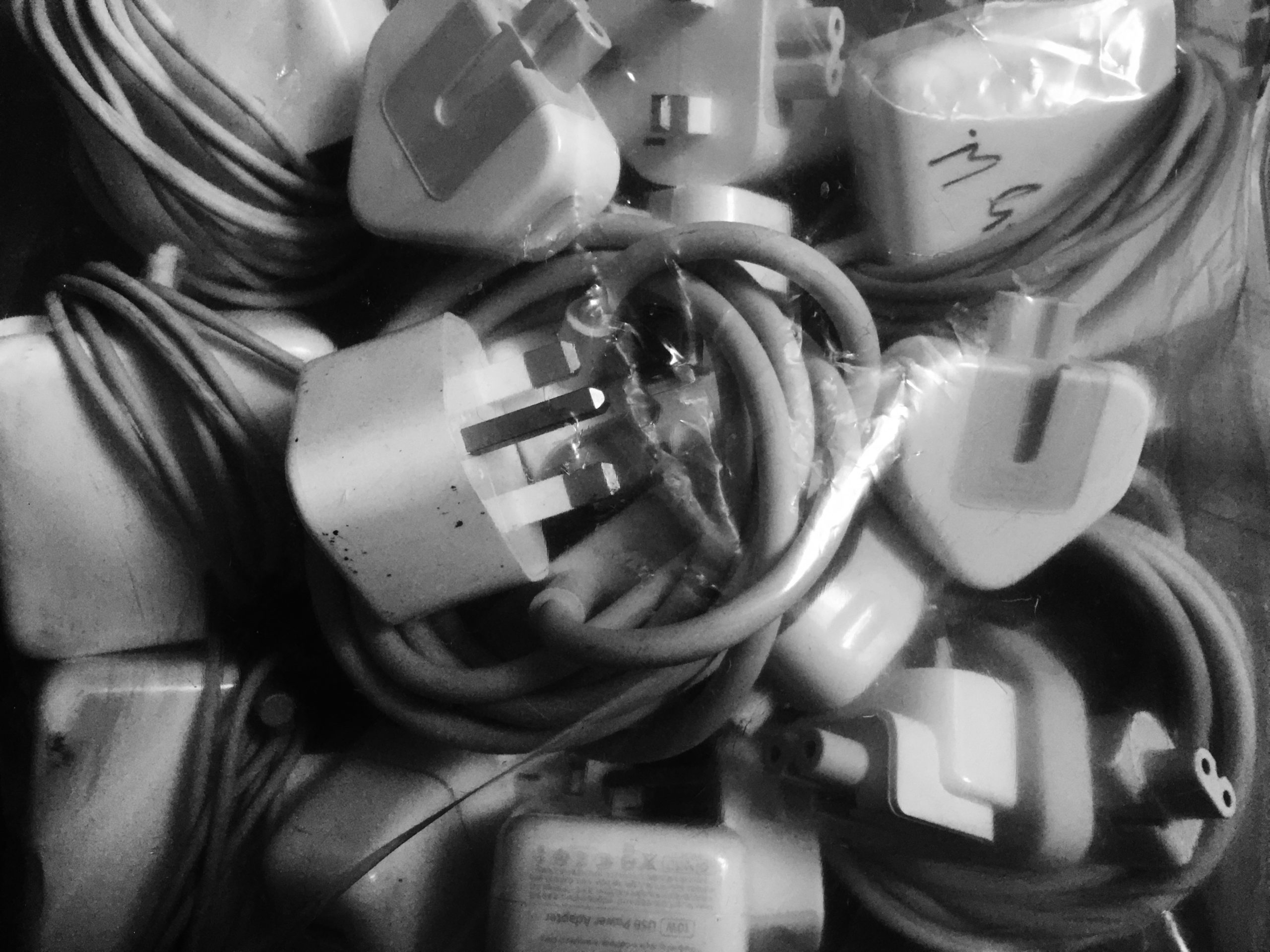
So frankly no one comes out looking good from this, and no one gets off the hook: Even device manufacturers. We have been encouraged to fetishise our gadgets, and to upgrade them as much as we can. Because we tend to hand back, pass on, or shove in a drawer our previous devices, we don’t quite realise what kind of footprint this covetousness leaves, and how much it costs us. I’ve not bought a new Apple device in years, but still I have a cupboard full of discarded cables, plugs and adapters:

Apple debris. Each plug and cable costs about $20, each adaptor up to $100. (author photo)

This is a vicious cycle of addictive devices, designed for lust and obsolescence, addictive services which push new content, nudge us into interaction, dangle rewards ahead of us, from which even the smartest and most mature of us are defenceless. And then give it to a three-year old, an eight-year old, a 12-year old. It was never going to be a fair fight.

I would like to see some justice. My confession is that I’ve been remiss in thinking that the more internet there was, the better off everyone would be. I remember CD-ROMs of Wikipedia being delivered to remote villages, of SMS being the poor businesswoman’s email lifeline. Now I see a device that is casting an addictive glow over the face of a generation of schoolchildren, from Jakarta to Djibouti.

Someone somewhere should hang their head in shame.

  1. Arthy CC, Effendy E, Amin MM, Loebis B, Camellia V, Husada MS. Indonesian Version of Addiction Rating Scale of Smartphone Usage Adapted from Smartphone Addiction Scale-Short Version (SAS-SV) In Junior High School. Open Access Maced J Med Sci. 2019 Oct 15; 7(19):3235-3239. https://doi.org/10.3889/oamjms.2019.691
  2. Influence of Adolescents’ Smartphone Addiction on Mental and Emotional Development in West Java, Indonesia, March 2019, Majalah Kedokteran Bandung 51(1):46-52
  3. Wahyuni AS, Siahaan FB, Arfa M, Alona I, Nerdy N. The Relationship between the Duration of Playing Gadget and Mental Emotional State of Elementary School Students. Open Access Maced J Med Sci. 2019 Jan 15;
  4. Dong H, Yang F, Lu X and Hao W (2020) Internet Addiction and Related Psychological Factors Among Children and Adolescents in China During the Coronavirus Disease 2019 (COVID-19) Epidemic. Front. Psychiatry 11:00751. doi: 10.3389/fpsyt.2020.00751

engagement’s battleground has shifted to groups

By | October 2, 2020

It’s always been about groups. Photo of Minitel by Nicolas Nova

It was ever thus: the internet was always about gathering and sharing. Even before the internet, the attraction of being connected was always less about access to services and information, and more for communing and community. The Chicago blizzard of 1978 helped propel bulletin boards, or BBS, into the mainstream. Usenet groups appeared a year later. The French makers of Minitel discovered around the same time that their test bed of users in Strasbourg preferred to hack the little desktop monitor and keyboard to chat with other users in the same building than find out when the post office was open. Two tools survived the internet’s shift to the web: email and usenet newsgroups.

So it’s no surprise that Facebook has woken up to the fact that if it’s stickiness you’re after, it’s better to build your business around people with shared interest than a shared history. (Of course the two can overlap.) As my friend Mar Pages has shown in her Facebook for groups – Everything you need to know page, this shift to groups goes back to (at least) 2017, when Mark Zuckerberg said that he wanted “develop the social infrastructure to give people the power to build a global community that works for all of us.” Of course, he would say that, but behind that was the obvious goal of trying to increase engagement. Groups had been around for at least a decade (turns out I am admin of at least four, though I can’t remember ever setting them up) but most (90%, according to Mar’s math) were not “meaningful communities” by whatever metric Facebook used, with a membership of only 100 million users. Facebook groups, in other words, were a wasteland.

So Facebook has been working on this, vowing in 2018 to boost membership to 1 billion members of meaningful communities and, in Mark’s (ironic, given what has happened since) words, “not only turn around the whole decline in community membership we’ve seen for decades, it will start to strengthen our social fabric and bring the world closer together.” Overnight it announced that there were 70 million administrators of what it called “active” groups — seemingly abandoning the term “meaningful” — and that there were 1.8 billion people using groups every month. This doesn’t really shed much light on how much progress they’re making, though it’s an advance on a 1.4 billion figure they released a year ago. It’s not unusual to move the goalposts but it suggests to me that Facebook realise that getting from 100 million to 1 billion in five years was a little too demanding, so now we’re getting something much more vague.

That said, there’s no denying the effort being put into Groups, and the boost it’s getting from Covid. But there are questions here that go deeper into the technopolistic world I wallow around in. What lengths will Facebook go to push people into Groups, how will it monetise this space, and when will it move to connect it to a much more active group-based app in its stable — WhatsApp? Finally, I’m wondering where the lines are going to be drawn when it comes to responsibility — will Facebook find it’s becoming more akin to a publisher, or will Groups allow it to offload that responsibility to admins and moderators, and if so, how does it reward them?

how far is Facebook going to go?

So, first question: how far will Facebook go to push us into groups? At the moment groups don’t contain in-line ads, so this is part of what Facebook has identified as an area which has seen increased engagement without monetization. Its announcement overnight was mostly focused on public groups — one you can see and browse without being a member — which will increase their visibility to non-members. It’s also allowing public group admins to generate revenue by allowing them to link up with companies to carrying branded content — sponsored content, to you and I. This does address part of the riddle of groups, which is why should admins and moderators dedicate so much of their time to these communities without any clear way to monetise it? Branded content goes some way to addressing that, though clearly Facebook is wary of allowing ads in private groups, since the subject matter may be sensitive and an ad unsuitable, ill-timed or worse, offensive.

To me the biggest challenge for Facebook is how to monetise WhatsApp which outside the U.S. has largely replaced SMS and is much more popular as a messaging app than Facebook Messenger or any other messaging app. I am a member of dozens of groups, often very specific to an event, a location, an interest or a relationship. It seems obvious that at some point Facebook, obsessed with monetizing ‘engagement’, has to try to lure this group of people into one of its money-making funnels. The Verge reported earlier this week reported that Facebook is now making it easier for people to post messages across Facebook, Instagram and Messenger, an early step in a plan announced last year to essentially combine the three with WhatsApp into a private services platform, not unlike something like WeChat. While Groups isn’t ostensibly part of this, in my mind there’s not much difference. To me there’s a much greater difference between a public Facebook and a private one, than with a private Facebook group and a WhatsApp group. The former is Twitter, essentially, where what you say is by default public, and you know it is (and behave or misbehave accordingly.) Private groups are where you know, or feel you know, the other people on that group, and behave quite differently. While WhatsApp groups are always going to be relatively small, they’re still a huge chunk of our “engagement time” and they’re an advertiser’s dream, as are the private Facebook groups, since they’re focused on a specific interest.

Responsibility

So finally, responsibility. Who is responsible for the content of Facebook groups? Mar tells me there’s a lot of automated culling and cuffing on groups, where even administrators find themselves suspended for activity that looks to Facebook’s bots as spammy. And of course Facebook has deleted thousands of perceived hate groups. So it’s hard for Facebook to claim it’s not responsible for content in these groups, even if most of the actual moderating is left to administrators and moderators, who are not Facebook employees, are not paid or compensated by Facebook, and who are doing the work — often quite time-consuming, not to mention wreaking an emotional toll. A sign of the tide may be an Australian court’s decision in June which holds media companies liable for defamatory posts on their Facebook page. While the lawsuit doesn’t include Facebook, the case led to Australia saying it might treat platforms like Twitter and Facebook as publishers and therefore liable for defamation for anything posted on their pages.

So where does this leave us, and where is this going? For all its fancy talk, clearly Facebook can see the writing on the wall: that the future of social networking lies in shared interests, just like the internet discovered itself. The shift to newsletters has shown that interests cannot be too niche, and that people love to talk to other people who have the same interest. But at the same time there’s a problem: Facebook has lasted this long, in my view, for two reasons: there are still a lot of people who haven’t signed up, and until everyone on the planet has joined Facebook the growth numbers will always look good. But the effort to keep people active on Facebook is like a hamster wheel: you have to keep feeding them compelling content, and there’s only so many foodie photos a user can take. This has led Facebook into rabbit hole not unlike the rabbit holes its algorithms such users into. If you have to rely on increasingly click-baity headlines and assertions to keep people engaged, at some point the snake starts to eat itself.

So there has to be an alternative. And that’s what groups are. Public groups are one thing, but that is not where the value is. That lies in the private groups, where passion, knowledge and value lie. But at the same time, who is in the driving seat for that? If the pull is strong enough for users, what’s to stop the owner of the group moving it to another platform, one which they are able to monetize and which offers more features? Think of a group as a walled garden within Facebook’s walled garden; if people already have to jump over one wall to access it, why not just move the inner walled garden somewhere else, since the friction — the effort required to reach the group — would be no different.

That said, I’m sure this won’t happen, at least immediately. But at some point the owner of a group of hundreds of thousands of passionate users is going to recognise that none of them are there because it’s Facebook, but because Facebook happens to be the platform. Somehow Facebook will have to find a way to lock in group owners with golden handcuffs, or win them over.

a solution to facebook: regulation, yes, but also a simpler tech

By | September 18, 2020

(Facebook HQ, 2024) Rust | Ampersand72 | Flickr)

The Social Dilemma (Netflix) does a great job explaining how Facebook and Google work, and, dare I say it, completes the picture I’ve been trying to paint in previous blog posts better than I could. It’s definitely worth a watch: essentially, the business model of both (and therefore nearly all digital-only business) relies on capturing, retaining, diverting and monetizing your attention. The sleight of hand is to make you feel that you’re connecting to your friends and interests. Whereas in reality you’re being sucked into interacting long enough to get your attention diverted to advertising.

So we knew that, we just didn’t necessarily know exactly how it worked, and how sophisticated and relentless it was. The documentary’s conclusion: It can’t be beat with technology. It needs regulation.

That’s where I’d disagree. Definitely there needs to be regulation. The Buzzfeed piece on the leaked memo of a fired Facebook employee (I don’t really see the need to share her name as she didn’t consent to it being used) illustrates just how little effort and resources Facebook has put into patrolling itself.

Indeed, the opposite: Bloomberg Businessweek this week shows how much effort Facebook has put into not having to patrol itself. Here’s the piece’s broad assertion:

Zuckerberg isn’t easily influenced by politics. But what he does care about—more than anything else perhaps—is Facebook’s ubiquity and its potential for growth. The result, critics say, has been an alliance of convenience between the world’s largest social network and the White House, in which Facebook looks the other way while Trump spreads misinformation about voting that could delegitimize the winner or even swing the election.

In other words, not only is the world’s largest social platform aware of the extent to which misinformation and misdirection can shape an individual’s beliefs — about themselves, about other people, about their country’s leadership — but that this can actually become a lever for political cover to support the company’s growth.

So it’s obvious, a no-brainer, that regulation has to happen. Regulation needs to be in place holding these platforms responsible, effectively, for every piece of content that is on there, in the same way any publisher or broadcaster is responsible. While some of this could be automated — searching for bots, tweaking algorithms so conspiracy theories don’t become memes that suck the vulnerable further down a lucrative but self-destructive wormhole — much of it is going to have be manual. As the leaked memo illustrates, a lot of this is just too hard to leave to computers; nor can it be done by outsourced drones. I don’t see any other way around it.

Sure, it’s going to hurt their margins, may even make parts of it unprofitable, but I believe the equation is quite a simple one. If Facebook alters in any way content that we post to it then it becomes a publisher, and so acquires the rights and responsibilities of a publisher. It does that all the time, prioritising some stuff over others, converting the links you add — checking first whether it is a banned link or not — to one that will then, when you click on it, warn you that you’re leaving Facebook. All of this is the hallmark of a publisher, so it’s obvious that eventually Facebook, and every digital platform like it, will be required to comply with the law affecting publications.

Not all of this will be good. In some countries restrictions on publications are politically onerous, but it’s inevitable. It will be a test of Facebook’s mettle about whether it will allow itself to become a quasi state broadcaster or publisher under such conditions, but that’s talk for another day.

For now I want to offer a simple alternative. We already have a solution to the problem of Facebook, Twitter etc, if all we’re looking for is a simple way to stay in touch with people, institutions and news. It’s called RSS.

RSS, or rich site syndication/really simple syndication, is a standard allowing updates to be fed from a source to a recipient without lots of complicated clutter in between (accounts, passwords, cookies etc, unless you want them). For a while it was the darling of the world. Certainly mine. It’s been around since the halcyon days of 2000/1, when there was little interest in monetizing content, or dumpster-diving for personal information. Indeed part of its beauty lay in the fact that you could subscribe to something without the producer of that content needing to even know your email address.

Indeed, RSS was the (technical) model that Facebook and Twitter drew on. Arguably it was the failure of RSS to adapt (and get itself out of a fratricidal hole) that opened the space up for Facebook and Twitter to move in. But essentially the principle has always remained the same: a river of content, selected by the user, pushed rather than pulled, which can include text and multimedia.

I haven’t ditched Facebook yet because it helps me understand the scale of the problem a little, but it’s largely a wasteland for my friends, most of whom are no longer on Facebook, or have disappeared from my feed because of poor algorithms (yes, the black box eventually disappears up its own ass, I suspect, as it tries to dig us every deeper rabbit holes).

Facebook, and to a certain extent Twitter, have left the door open to an alternative in part by fiddling with that river model, which leaves open an opportunity. There’s no reason RSS couldn’t rise to the occasion and replace it.

If I could easily subscribe to a personal RSS feeds of my friends in a simple, secure environment, free of sneaky attention-seeking widgets, I would be deliriously happy. We would be free of the neediness of desperately seeking approval, the worry that we may have missed something, the ads, the distractions.

Perhaps someone has done this already. And of course there would be issues. But we have to start somewhere. I’m not talking about a platform; I’m talking about a standard, that could be used by any app, even existing ones like email or chat, or a browser.

And I do agree with two other points made on The Social Dilemma:

  • that this technology is not going to go away. That the ability to influence us, to outsmart us, is not going to remain at this level. It’s going to improve. And we aren’t showing any signs of getting smarter, definitely not at the same rate;
  • that we shouldn’t allow those with technology to try to kid us into thinking they have the solution to the problem they have created.

But those points to me suggest another solution: an appropriate technology solution. Perhaps we don’t need something so complicated to stay in touch with our friends. I have resurrected an old (non-digital) birthday calendar and I try to make a point of sending birthday greetings to anyone on it. I feel that is cheating less than having a digital calendar, or Facebook, do it. So perhaps staying in touch with our friends, either on a daily basis or an annual one, doesn’t need to be overly complex either.

Anyone care to start the ball rolling?

the digitally ass-backwards age

By | August 31, 2020

Just because it can be found doesn’t mean it’s worth indexing

We’re living in a digitally ass backwards age, where everything you do of commercial monetary value is retained, amazingly easy to recover and commercially mined at mind-boggling speed, but everything else — photos, an SMS, an email you sent to someone last week, the deed to your house — is lost in the muddle of that drive an inch or two from your finger tips.

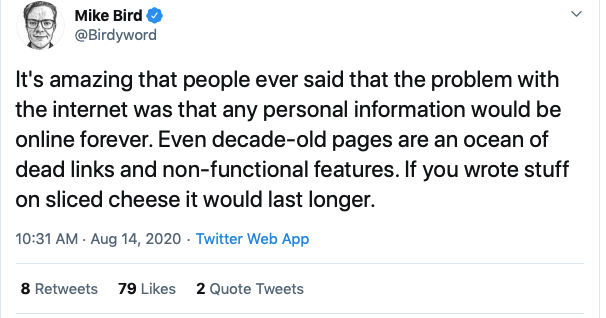
Mike Bird’s tweet above is one illustration of this paradox. But perhaps the best one is this: I have a vast database of stuff I’ve collected over the years from the internet. But although I use the best tools out there to index that stuff, it’s still much easier to search for those documents on the internet via Google. Easier as in faster and more thorough (more documents, newer versions). It wasn’t always so, however. For one thing, the internet wasn’t always faster than your apps+your hard drive.

For another, Google used to have an excellent tool called Google Desktop which searched your computer for you while also searching the net. This was during the wonder years of 2004 through to about 2008 when software was Good, in both senses of the word, and the idea of indexing your hard drive and making things easy to find seemed like a worthy cause; some of you may recall Enfish and some other efforts in this field, which I suspect Google Desktop killed off before it took its own life, probably having completed its mission.) For a heavenly few years the two were united: what you had in your computer and what was online were one and the same.

Enfish: out of its hands

But Mammon won. Because the simple calculation was: there is no commercial value on your hard drive because privacy prevents Google from mining that data or learning intent from your searches so why would we waste money on that. Once Google had won the search engine wars in the 2000s (see my post on that here) which was what the Google Desktop war was about, Microsoft being their main competitor at the time), there was simply no commercial imperative in continuing to support Google Desktop. Besides, by then we had been persuaded to move most of our email onto the web, so why would we want to be searching our hard drives anyway? There really is no market for what I, foolishly, once believed was the future of the browser. To me then, and now, I still can’t quite figure out why would you NOT search the web and search your own computer at the same time?)

So in short: search is only valuable to the provider of that search if it is to look for things of commercial value, and things we have not yet purchased, and things we might intend to purchase, and have the means of purchasing. It’s not hard, when you look at it that way, to see how things have skewed, in the past 20 years from a paradigm of: “Your computer! It will be where you will create and save all your memories, your documents, your house plans, your photos, all in one place! Forever!” To: “Your devices! You can consume anything you like! Whenever you like! Instantly! Forget about the future! Live for now!”

OK, that’s obvious for the ‘order now from the gig economy’ world. But it started long ago. It started with iTunes, and continued with things like Kindle. Those digital books you ‘bought’? You don’t own them. You bought a license. You die, that book reverts to Amazon. You might be able to save those items somewhere, but you can’t really do anything to them as if they were yours, you can’t search them outside the Kindle app. They are imprisoned. 

And yes, it’s true that your photos are saved from your camera relatively seamlessly to other devices, except it’s less than obvious how, evidenced by all the hours you spend trying to find a photo from that birthday party ten years ago that should have been saved to a computer but doesn’t seem to have been because that computer was upgraded a few years ago and doesn’t seem to have been moved across, or the WhatsApp message that was on an old phone or an email that was on an old account which you ditched when they started charging outrageous fees for attachments. Or automatic online and time machine backups which all go smoothly for years until you actually need to restore something in which case the one file you need is missing. And did you know that hard drives actually only last five years tops? Assuming you’ve been using hard drives to back up your treasured memories for 15 years (20 in mine) that means you should have replaced those hard drives at least twice.

In short, even if you have been doing everything right, you’ve been doing it wrong. 

Our digital world is built to be commercially optimised for speed, not for ensuring our memories, our records, our heirlooms, belong to us, and are safe. This is not to say companies like Apple don’t try to sell us the whole shebang, make us feel that by selling us computer+services+software that we’re still in that 20-year-old paradigm of ‘your own computer where only good things happen’ but in fact it’s better to think of it as as a big shopping cart. Few of the things you do with it you actually create or produce, and while Apple does offer some tools to help you move stuff from one old device to another, the emphasis is not on safeguarding your ‘digital heritage’ as much as persuading you to keep subscribing to their digital services — to expand your plot in their walled garden.

Now you could argue, I suppose, that Facebook has taken a different approach, building a business on digital longevity, lovingly creating a website that thrives on us tending to our shared memories. And perhaps there’s some truth in that. But let’s explore that for a moment. Can I easily search my memories for something? Sort of. I suppose if I organised things correctly I could find a birthday party album. But the search bar on the timeline doesn’t seem to work, and the best way to navigate seems to be by year. That is a tedious option. Overall, the Past in Facebook world seems to be something for the company’s algorithms to dish up occasionally, rather than a place for us to explore. Like Google, Facebook presumably has less interest in it because it’s not reflective of our present or upcoming needs and desires.

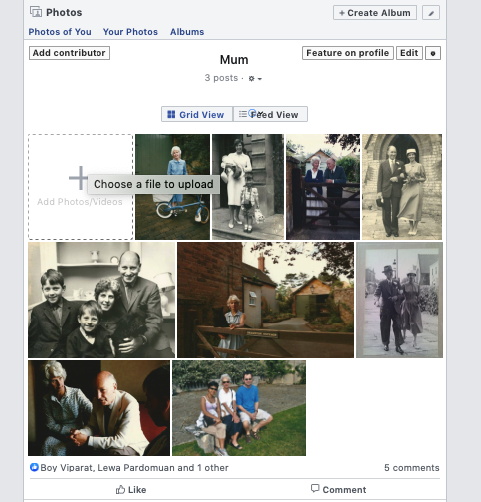
It’s time for us to apply some pressure for the commercial world to stop thinking like this. We have given so much of our lives and data to these vast harvesting machines it’s time to wrest some of it back. And not just to demand the data, but to demand it in the format that we left it in. For example: You can now download your data from Facebook and Google but this is all — intentionally, in my view — in such a mess that it would take a year to put it some order. It is absurd, in my opinion, that the tools to curate our footprint online are impressive (in Facebook, for example, I can create an album called ‘Mum’ to remember my mother, where the photos are dated, geotagged and name-tagged, where they are displayed as thumb-nails and where I can choose who can view them and where those people can comment. This is all assumed as based features.

Facebook cares about me and my memories, so long as I don’t’ try to find them, or download them some place else

Now if I want to download that album to my computer, how do I do that? It took me one minute (not too bad, considering) to figure out that (arguably) probably my best option was to download all my photos. This of course may take some time. So while that was going on I decided to right click and download the photos individually. Now to be fair this is not as hard as it could be (in Safari, right click on the image, download as image to the default folder). The problem is that all that richness and effort is lost: The filenames are now meaningless — 30535610150348063416882213385n.jpg rather than 1959 Mum with baby Aldrich.jpg— the metadata is gone, the geotagging, the people tags, the comments, the albums. All that curating work you did on Facebook is for naught. It’s a stark reminder that the tagline about Facebook caring about you and your memories is a flagon of balderdash. (The download process is no better, though the albums are at least in separate folders.)

So that’s the first step. I will talk about future steps in future columns. Perhaps this Covid-19 year (and some of next, no doubt) will not be such a waste. We will realise the devices in front of us are not just oversized credit card swiping machines or pocket-sized cinemas, but actual treasure chests for organizing and storing our heritage, our heirlooms, things we can create and pass on. But first we need to reclaim them. This needn’t be a zero sum game. The Walled Garden machines can help us do this, and expand their business models to include better, more resilient home networks that include resilient storage, tagging and search (more of this in a future column.)

For now, start thinking: all this digital gardening you’re doing? Who is it for? And will it leave it a trace for anyone but those hordes of digital marketers?